



















Designing a Reliable Battery Backup Solution for Street Lights in High-Temperature Environments
A Real Project Experience from the Middle East
This article is based on a real technical project in the Middle East. Customer-specific information has been omitted to protect project confidentiality.
Introduction
Designing a battery backup system for street lighting is about much more than selecting a battery with enough capacity. In high-temperature regions, long operating hours, harsh outdoor conditions, and power reliability all have a direct impact on system performance.
Recently, GMCELL supported an infrastructure project in the Middle East that required a battery backup solution capable of powering LED street lights for up to 14 hours during utility power outages. While the backup duration was an important requirement, the customer’s primary concern was whether the complete system could operate reliably under local environmental conditions.
Instead of requesting only product recommendations, the customer asked for a complete technical package, including official connection diagrams, battery sizing calculations, controller specifications, product datasheets, and a detailed explanation of how the system would operate.
This project highlights a growing trend in infrastructure projects: customers are looking for complete technical solutions supported by engineering documentation rather than simply purchasing individual products.
Project Requirements
The backup system needed to meet several key requirements:
- Support LED street lighting for up to 14 hours during utility power failures.
- Operate reliably in the high ambient temperatures typical of the Middle East.
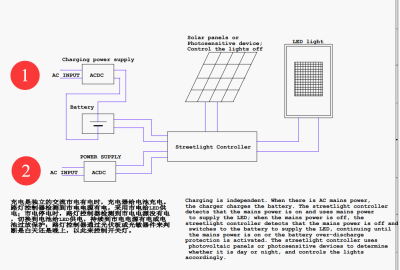
- Automatically switch between utility power and battery backup.
- Maintain continuous battery charging whenever AC power is available.
- Protect the battery against over-discharge.
- Minimize maintenance throughout the system’s service life.
Each requirement influenced the selection of the battery, controller, charging strategy, and overall system configuration.
Complete Technical Documentation Was Essential
One aspect that stood out during this project was the customer’s emphasis on technical documentation.
Before approving the proposed solution, the customer requested a complete documentation package, including:
- Official connection diagrams
- Battery sizing calculation sheets
- Controller sizing calculations
- Product datasheets
- System operating logic
- Technical specifications for key components
This documentation allows project owners and technical teams to verify that every component has been selected according to actual operating requirements rather than assumptions.
For municipal infrastructure and public lighting projects, this level of documentation has become an important part of the technical review process.
Battery Sizing Is Based on Calculation, Not Estimation
One of the most common misconceptions in outdoor lighting projects is that selecting a larger battery automatically creates a better backup solution.
In practice, battery capacity should always be determined through calculation.
Several factors must be considered, including:
- LED power consumption
- Required backup duration
- Battery depth of discharge (DOD)
- Charging efficiency
- System losses
- Ambient temperature
- Safety margin
By evaluating these factors together, the appropriate battery capacity can be selected while avoiding unnecessary costs and ensuring the required backup time is achieved.
System Design for Reliable Operation
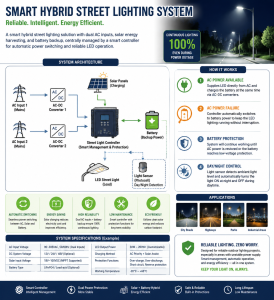
The proposed solution was designed to provide reliable operation under both normal and emergency conditions.
During normal operation:
- Utility power supplies the lighting system.
- The battery remains fully charged through the charging circuit.
- The controller manages lighting according to the day/night signal.
If utility power is interrupted:
- The controller automatically detects the outage.
- The battery immediately supplies power to the LED luminaire.
- Battery protection functions prevent excessive discharge and help extend battery life.
The complete operating logic was supported by an official connection diagram and calculation documents provided for technical review before implementation.
Why High-Temperature Environments Require Special Attention
High ambient temperatures can significantly affect battery performance and long-term system reliability.
Simply increasing battery capacity does not solve these challenges.
A reliable solution also depends on:
- Selecting the appropriate battery technology.
- Designing an efficient charging strategy.
- Choosing a compatible controller.
- Providing suitable electrical protection.
- Considering installation conditions and heat management.
When these factors are properly addressed, the system is better prepared for long-term outdoor operation.
Practical Experience Makes a Difference
Every project presents unique technical requirements, especially in regions with extreme environmental conditions.
Beyond this street lighting project, GMCELL has also participated in energy storage projects with China Comservice Saudi Arabia, gaining valuable experience in designing reliable outdoor power systems for high-temperature environments.
This practical project experience helps us better understand the challenges associated with long operating hours, extreme heat, and demanding infrastructure applications across the Middle East, allowing us to provide solutions supported by real-world project experience rather than theoretical assumptions.

Conclusion
A reliable street lighting backup system is built on much more than high-capacity batteries.
Accurate calculations, appropriate component selection, complete technical documentation, and careful consideration of environmental conditions all contribute to long-term system performance.
As infrastructure projects continue to demand higher reliability, providing calculation sheets, connection diagrams, and product datasheets has become just as important as supplying the hardware itself.
Real projects continue to demonstrate that successful energy storage solutions are achieved through thoughtful system design and close technical collaboration from the earliest stages of a project.
Key Takeaways
- High-temperature environments require careful system design rather than simply increasing battery capacity.
- Battery sizing should always be based on actual operating requirements and technical calculations.
- Complete documentation—including connection diagrams, calculation sheets, and datasheets—is essential for project evaluation and approval.
- Automatic switching and proper battery protection improve long-term system reliability.
- Practical experience from real energy storage projects helps deliver more reliable solutions for challenging outdoor environments.
Frequently Asked Questions (FAQ)
Why is battery sizing important for street lighting projects?
Battery capacity should be calculated based on lighting load, backup duration, charging efficiency, battery depth of discharge, and environmental conditions. Proper sizing helps ensure reliable backup performance while avoiding unnecessary costs.
What documents are typically required before approving a battery backup solution?
Most infrastructure projects require official connection diagrams, battery sizing calculations, controller specifications, product datasheets, and a description of the system operating logic before final approval.
How do high temperatures affect battery backup systems?
High ambient temperatures can accelerate battery aging and reduce long-term performance if the battery type, charging strategy, and protection methods are not properly designed.
Can the system switch automatically during a power outage?
Yes. A properly configured controller can automatically detect the loss of utility power and transfer the lighting load to battery backup without manual intervention.
À propos de GMCELL
GMCELL specializes in customized battery backup and energy storage solutions for outdoor infrastructure applications. From street lighting and telecommunications to industrial power systems, every solution is developed around real project requirements and supported with technical documentation, including calculation sheets, connection diagrams, and product datasheets. Our goal is to help customers build reliable, efficient, and practical power systems for demanding environments.